
They Were 11! (I’ll be omitting the ! from the title from now on, because it’s a bitch to punctuate) is a short sci-fi manga from shoujo manga legend Moto Hagio about a team of ten applicants to a prestigious space academy. As the final part of their entrance exam, they’re sent to a derelict spaceship and told to survive there for 53 days with no outside contact — at which point they realize there’s an extra person, and they have no way of knowing who it is. (I’ll be using the 1986 OVA for screencaps because the manga only just got licensed and the only scans available are terrible; the OVA is a very close adaptation anyways.)
One of these 11 applicants is Frolbericheri Frol, who I will be referring to with they/them pronouns, because that feels like the safest option. When Frol first takes off their helmet, everyone assumes they’re female based on their appearance¹ — Frol is furious and insulted, saying they’re a man and they hate women, using the very masculine first-person pronoun “ore.”

For what it’s worth, everyone seems to accept this, despite their extremely feminine appearance and mannerisms. Part of this is probably due to one of the other applicants — our viewpoint character, an Earth human named Tadatos Lane — possessing something of a sixth sense in the form of preternaturally precise and accurate intuition, including the ability to tell when others are lying. Frol isn’t lying when they say they’re a man.
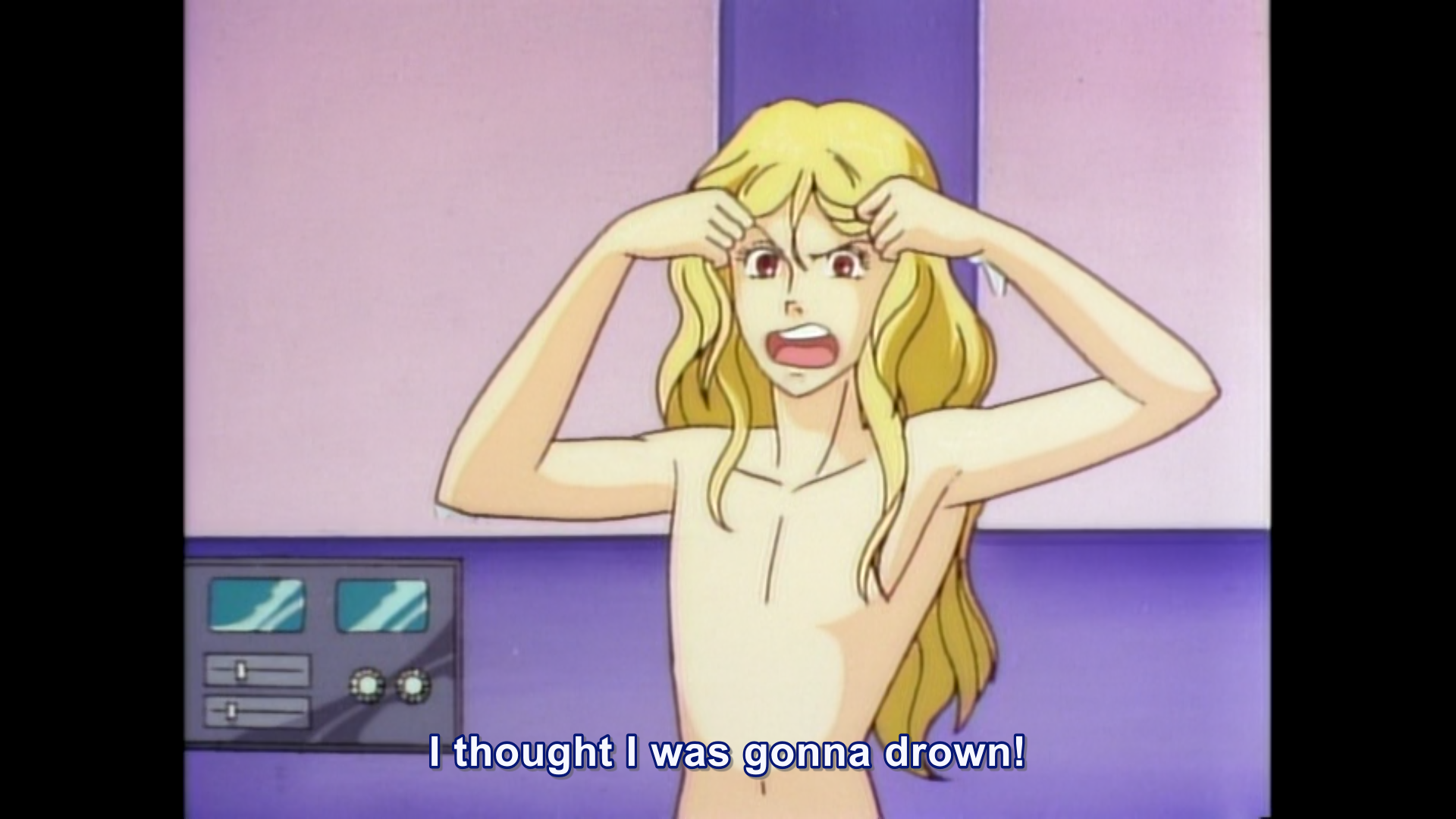
We get the whole story when a shower mishap gives another teammate a full view of Frol, and despite the flat, masculine chest the camera shows, designates them female and calls a group meeting to demand an explanation. One of the other applicants — a nonhuman named Vidmenir Knume — provides it. Frol is what’s known in his culture as a “menir” — an as-of-yet sexually undifferentiated person who will eventually grow to be either male or female. For Knu’s species, this development occurs naturally²; for Frol’s, it’s induced. Based on Frol’s reaction to everyone’s surprise, and the fact that at one point they ask Tada if he’s been a man long, it’s possible they weren’t aware that sexual development with a menir stage wasn’t the norm.

As Frol explains it, they’re taking the exam to become a man. Their planet is misogynistic and patriarchal — only the eldest children are allowed to become men, resulting in a ratio of five or six women to every man and a society where men rule and women work. If they stayed there, Frol would be forced to become a woman; if they can pass the exam, they’ll be allowed to become a man. Everyone more or less moves on after this explanation, since they have more important things to worry about, but it’s obvious that at least Tada and their other roommate have started thinking of Frol as a girl.
Anyways, you can probably see where this is going. Everyone thinks they’re going to fail, Frol is lamenting having to become a woman, Tada says if they do he’ll marry them, everyone finds out they’ve actually passed, Frol decides to become a woman and marry him anyways. That’s right — it’s not about genderqueerness, it’s using the lens of genderqueerness to talk about sexism.

What Frol wants to escape isn’t “being a woman,” it’s the role of womanhood in her society. And she does; she passes the exam because she’s smart and tenacious and becomes a spaceship pilot. The core message is the same as it always is with these things — “you don’t have to be a man to accomplish your goals, even if society says you do.” Frol escapes the role of womanhood while still becoming a woman. And all of their insistence on being a man and anger at not being recognized as one and absolute despair at the thought of having to become a woman — that was all just internalized misogyny.
So yeah, this is TERF rhetoric. “Trans men are self-hating women.” The fact that Frol is a menir keeps it from being the worst example of this — it’s not clear whether or not innate mental gender as humans conceive it even exists in their species, or if sex and gender are just a physical representation of social roles. If so, it would be as simple as Frol wanting to go to the academy to better their prospects, which has nothing at all to do with gender.

It’s hard to argue that this doesn’t look like a trans metaphor gone wrong, though. Even if Frol is neither male nor female, they’re clearly intended to be read as female by the audience — meaning you have an extremely feminine individual insisting on being/wanting to become a man before deciding no, they actually are/want to become a woman. I can’t say I care for it, but They Were 11 is from 1975, so I can’t say I’m terribly surprised either.
So, how to improve this in terms of rep. Like I said above, you could make Frol a cis girl who wants to escape her patriarchal society, which would negate the issue; however, it would require some decently heavy rewrites around when and how information is revealed unless Frol is posing as a boy for whatever reason, which would be its own problem. Alternately, giving Frol a more androgynous/less feminine appearance would make it read less like a trans metaphor by emphasizing the fact that they aren’t yet male or female. It’s tricky, though — Frol’s menir status is so tightly entangled with their arc and the plot that it’s hard to pull apart.

Upon revisiting They Were 11, I’m struck by how much of its influence I can see in other intersex and menir-esque anime and manga characters. Astra: Lost in Space is already clearly drawing inspiration from the premise of They Were 11; I can’t imagine Luca Esposito wasn’t a response to Frol, even if their circumstances are very different. The world of Simoun has something very close to menir; everyone is born female and chooses a permanent sex at 17, and much of the series is examining what it means to “become a woman” or “become a man” under such conditions. Izana Shinatose from Knights of Sidonia is a menir who permanently becomes either male or female upon finding a partner — if I remember correctly, the way that’s handled is rather weird and fetishy, but even so.
Frolbericheri Frol is far from the most thoughtful depiction of genderqueerness — if they can be called genderqueer at all — but it’s undeniable that they paved the way for similar characters and modes of being down the line, and I can’t help but love them for it.

¹ – Some of them also assume that Frol’s the 11th person because of this — I don’t know if Hagio was writing for a shonen audience, but the fact that Frol is the only character who isn’t male has always bothered me. There’s a comment about how “lots of girls take the exams,” but it certainly doesn’t seem that way.
² – Based on this, I imagine “Vidmenir” is probably not a name so much as a form of address for one who isn’t a menir, possibly equivalent to “Mr.” since Knu seems to be male. It would make sense for a culture that uses mononyms to adopt something like that to deal with forms that expect family and given names. Or it might be a completely unrelated homonym and I’m overthinking this nonexistent language.
 Allegory, Allegorier, Allegoriest
Interesting take on Frol. I have to say, I don’t agree that the author is coming to it from a TERF point of view, though. Hagio Moto did a lot of unusual (for the time) things with gender in her writing, and she definitely didn’t hit the nail on the head by current standards. However, she’s always spoken positively about queerness when asked. A lot of her writing about gender is related to her coming to terms with her own gender, sex, and internalized sexism. Also, unlike most of her peers, she has never married nor had children. I think one can see her come to terms with this through her writing from the 70’s and 80’s into the 90’s. For this reason, I’d say she’s more introspective than polemic.
In another of Hagio Moto’s manga, another intersex person with fantasy biology ends up specifically rejecting any notion of gender, neither aligning with the men of the surrounding culture nor taking on a mythical matriarchal role several of these men try to force upon them. In the end, their rejection of these gendered expectations leads them down a different path. Their psionic power, which does not stem from their gender and was inherited from an unwilling father whose own bodily autonomy was both curtailed by the law and violated, ends up being what saves the world. The story also concerns itself with how destructive obsession and mythologizing around reproduction can be. Not a perfect story, very of its time, but I don’t think a terf would like it.
In yet another manga, a young AMAB man discovers that his genes are XX. Others encourage him to transition, but he’s happy as he is and ends up falling in love with another man due to a shared love of science and interstellar hang-gliding. Though the story does talk about how he came to be born XX (and that part in itself is a sad tale of why good gender-affirming care should be available rather than self-medication being the only option), his boyfriend never encourages him to transition and accepts him as he is.
Even They Were 11 only works as a terfy story if we see Frol as intentionally female-coded. Having read a lot of her manga, Hagio Moto really likes to draw pretty men with long hair. There’s even another man in They Were 11 who has even more stereotypically “yamato nadeshiko” hair, but he’s just a guy. I think her art style is probably leading us down a path Hagio Moto didn’t fully intend. Different mangaka, but Oscar in the Rose of Versailles has a similar aesthetic, yet Oscar is explicitly meant to read as masculine despite being AFAB and arguably a woman. With the characters in They Were 11 being so young, sexual differentiation is even harder to show. I’d say that Frol looks like a bishounen of their time, I’m not convinced they’re meant to read “girl” to us.
Sorry if this has all been a bit scattershot of me, and sorry if I’ve made some assumptions. (I’m nb and intersex, I’m assuming you’re at least trans too.) I admit I get a bit emotional about this because Hagio Moto’s writing was some of the first content I discovered with characters that felt like me. Her stuff is very of its time for sure, I never recommend her stuff to my friends because it looks very sus in our eyes today. I get that I’m probably not going to change your mind on this one. That’s fine, we can have different opinions. I just wanted to put my 2 cents in too. Thanks again for the very interesting post, please keep up the good work!
LikeLike